
Why the faces hold from shot one to shot fourteen
/ The short version:
- Characters drift between shots because each shot is a separate throw of the dice from the same words, and words cannot specify a face.
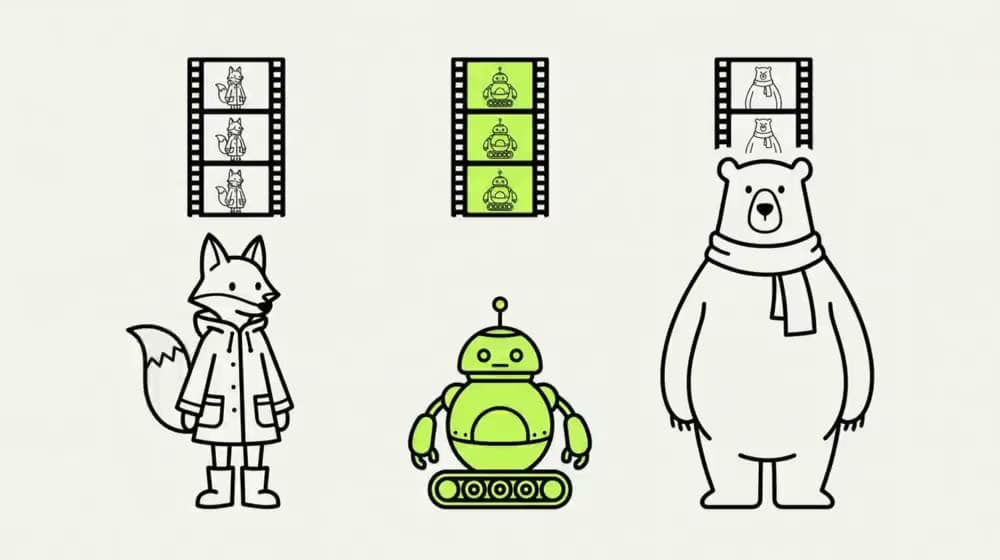
- A cast member here is an object with a locked description, a chosen canonical render and an eight-pose identity sheet.
- Every later shot is filmed with that approved picture as its reference, so the model is handed the character rather than asked to imagine them again.
The commonest way a generated film falls apart is that the person in it stops being the same person. Shot one has a girl in a green coat. Shot six has a different girl in a similar coat. By shot fourteen nobody is watching the story any more; they are watching the face change.
/ In this post:
Why characters drift in the first place
It is worth being precise about the cause, because the cause tells you which fixes can possibly work. Each shot is generated independently, from a text prompt. If the prompt for shot one and the prompt for shot six both say “a girl in a green coat with dark hair”, the model is not being asked to continue anything. It is being asked the same question twice, and it is entitled to answer differently both times.
You can make the prompt longer. People do — freckles, the exact green, the shape of the collar, the height relative to a doorway. It helps at the margin and it fails in the same way, because a paragraph of English still does not pin down a face. There are a very large number of faces consistent with any description you can write, and the model picks one each time.
Seed locking is the other common attempt. Fixing the random seed makes the same prompt produce the same image, which sounds like the answer until you remember that the whole point of shot six is that it is a different prompt: a different angle, a different action, a different room. Change the prompt and the seed no longer protects you.
Ask for a girl in a green coat fourteen times and you get fourteen girls.
Casting once, as a first-class object
The fix is not a better prompt. It is to stop describing the character per shot, and to make the character a thing the project owns.
When the treatment is written, the characters in it are pulled out into a cast. Each cast member becomes a record with a written look you can read, edit and lock, so that nothing downstream quietly rewrites it. Then you are shown candidate renders and you pick one. That choice matters more than anything else in this stage, because of what happens to it next.
The identity sheet
From the render you approved, an eight-pose identity sheet is produced: front, three-quarter, profile, back, and the expressions. This is the same device an animation studio uses for the same reason — a single front-on portrait does not tell you what the back of a coat looks like, and a shot from behind will invent one if you do not.
- A written look you can lock — the description is a field on the record, not a fragment of a prompt, and locking it means no later stage may edit it.
- You choose the canonical render — out of candidates, before anything is filmed. You choose the face rather than being handed one, and you choose it before it is committed to anywhere.
- An eight-pose identity sheet — front, three-quarter, profile, back and the expressions, so a shot from behind has something to be correct about.
- Your own face, if you want — upload a photo and it is cast by the same route: description, canonical render, sheet.
- Kept between projects — a cast you approved is still there in your next film. A recurring character is a real thing rather than a description you paste again.
The mechanism: the reference is a picture
Here is the part that actually does the work. Once you have approved a still, that still is passed as a visual reference to every subsequent generation of that character. The model is not being asked to imagine a girl in a green coat again. It is being handed this specific girl and asked to put her in a different pose, in a different room, at a different distance.
That is a categorically different request, and it is why the look survives the film. Nothing is being re-guessed, so there is nothing to guess differently.
The same principle runs one level further into the filming stage: the last frame of one shot seeds the next, so the light and the place carry across the cut as well as the person. A character who walks out of a warm room into a cold one does it because the frames are chained, not because two prompts happened to agree about the lighting.
And the look is versioned
A look you change is a new version, not an overwrite. A descriptor that moved says which version it is on, so you can see what changed and when. More usefully, a shot filmed against an older version is flagged as stale rather than left to disagree silently with the rest of the film.
This matters because the failure it prevents is invisible. If you tweak a character in scene nine and the first eight shots quietly keep the old face, nothing errors; you just have a film with a continuity problem that you will find on the third watch, or not at all.
The cast is also what makes the other two outputs possible without re-inventing anything. A storybook draws its pages from the same approved renders, and a playable game uses the same cast as its sprites — because the cast belongs to the project rather than to the film.
Questions
How do you keep a character consistent across AI-generated shots?
Stop describing the character per shot. Cast them once as an object with a locked written description, choose a canonical render from candidates, generate an eight-pose identity sheet from it, and then pass that approved picture as the visual reference for every later shot. The model is handed the character rather than asked to imagine them again from words.
Does seed locking solve character drift?
Only for identical prompts. Fixing the seed makes the same prompt reproduce the same image, but shot six is a different prompt by definition — different angle, action and setting — so the seed stops protecting you exactly when you need it to.
Can I use my own face as a character?
Yes. Upload a photo and it is cast by the same route as any other character: a written description, a canonical render and an identity sheet, with every later shot filmed from the approved still.
What happens if I change a character halfway through?
The change creates a new version of the look rather than overwriting the old one, and every shot that was filmed against the earlier version is flagged as stale. You are told which shots disagree with the current cast and what re-filming them would cost.